Formulation Architecture
Two Architectures.
One Platform.
Peptide compounds are not a single formulation problem. Molecular weight, polarity, and structural fragility vary widely across the class, so a single formulation approach cannot hold every compound stable. Ventra formulations are built on two distinct architectures under one platform — each engineered around the molecular weight class of its actives, and each designed to keep the compound intact from fill through the full dating period.
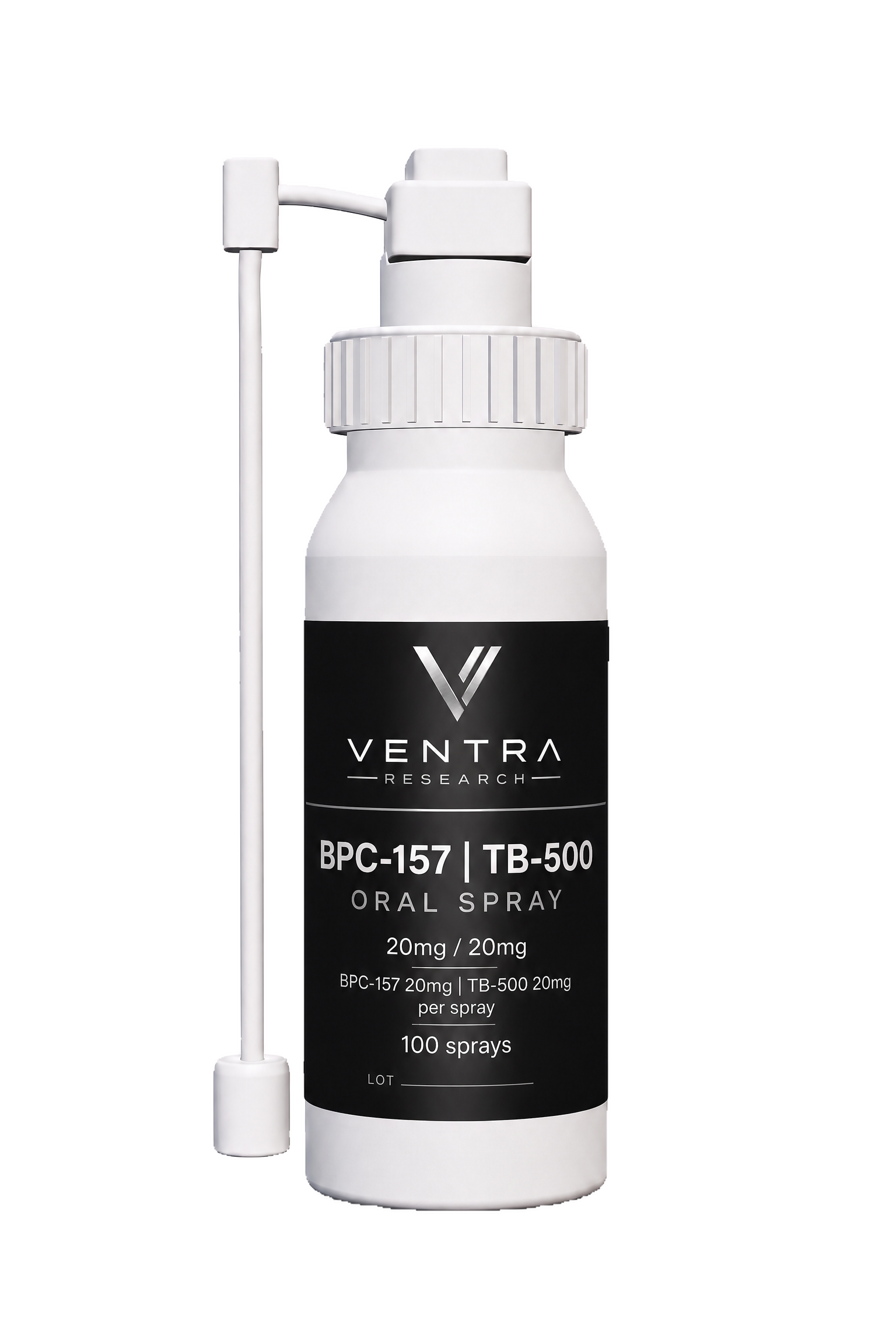
The intranasal architecture uses a single-cage molecular inclusion complex to shield active sites from enzymatic and oxidative degradation, with an amino-acid buffer holding pH at 5.3 ± 0.1. It is built for smaller-to-mid molecular weight compounds — Selank, Semax, Tesamorelin, Ipamorelin. The sublingual architecture uses a dual-host inclusion complex, a complementary multi-cage chemistry that fully encloses molecules too large for any single host cavity, buffered at 5.6 ± 0.1. It is built for higher molecular weight and more polar actives — GLP-2T, GLP-3R, BPC-157, TB-500, NAD+, MOTS-c, SS-31.
Across both architectures, a dual-pathway antioxidant system intercepts metal-catalyzed and radical-mediated oxidation, inert-atmosphere fill removes dissolved oxygen at packaging, and a glycomatrix stabilizer preserves structure across ambient temperature variation. The result is a research format defined by room-temperature handling, no reconstitution step, a 12-month shelf life, and a metered spray presentation.
Room Temperature
No Refrigeration Required
No Reconstitution
Ready-to-Research Format
Metered Spray
Modern Research Format
A Different Approach to Research Format.